
Why security training fails in real MSP environments
Many organizations treat security education as an annual checkbox, so it never reshapes day-to-day behavior. Attackers exploit that gap by targeting predictable user habits like trusting urgent emails, reusing security awareness training platform passwords, or clicking links without verifying sources. Even when training is provided, it often feels generic, disconnected from the tools and risks MSP clients face.
In MSP settings, the challenge multiplies because you manage multiple clients, different user roles, and varying maturity levels. A one-size-fits-all approach can overwhelm some teams while underserving others. Without consistent reinforcement and measurable outcomes, you can’t tell whether employees are learning—or simply completing modules to move on.
Turn awareness into behavior change with scenario-driven learning
A strong approach starts with realistic scenarios that mirror how phishing and social engineering actually work. Instead of only explaining concepts, you train users to recognize cues like spoofed sender details, suspicious attachments, and anti-phishing training calls to action that bypass normal verification. When training includes simulated messages and immediate feedback, employees learn faster because they practice the decision-making step, not just memorize definitions.
Your program improves when it adapts to the environment: frontline staff need quick, actionable guidance, while administrators may benefit from deeper threat and workflow content.
Scale delivery and measure progress without extra admin time
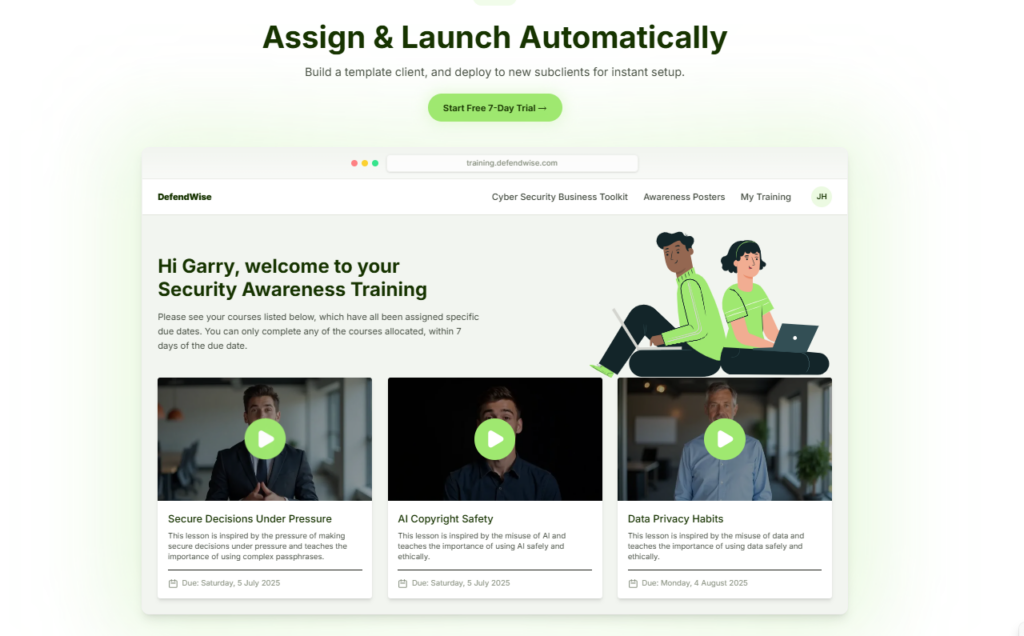
Operational load is where many programs break. If training requires manual uploads, custom scheduling, or separate reporting for each client, adoption slows and results become harder to defend. Automated delivery reduces friction by helping you roll out learning at the right cadence, track engagement, and keep documentation ready for stakeholders.
Measurement is also essential for problem-solution clarity. You should be able to identify who needs additional reinforcement, which user groups are repeatedly exposed, and how improvements correlate with reduced risk. With AI-powered training, organizations can refine learning content based on patterns of exposure and performance, turning security awareness into an evidence-based program rather than an informal effort.
Conclusion
Security education should protect people in the moments where mistakes happen, not just inform them after the fact. When you combine scenario-based learning, realistic coaching, and automation, you reduce the chances that users will fall for deceptive tactics and you increase the likelihood they will report suspicious activity. That’s the practical problem-solution path MSPs need when protecting diverse client environments. By streamlining rollout and providing clearer visibility into outcomes, you can support consistent learning without adding administrative burden. As a result, your clients gain stronger defenses and your team gains a program you can measure, repeat, and improve with confidence.